.png)
.png)
10 Features to Look for in a B2B Website Builder for Wholesalers


Key Takeaways
Not all B2B website builders are built for wholesale. Here’s what to look for when evaluating one:
- Pricing is account-specific: In wholesale, every buyer sees their own pricing, volume discounts, and terms.
- Controlling catalog visibility: A wholesale website builder lets you control product visibility at four levels: product, category, brand, and customer group.
- Integrations reduce manual work: Connecting your platform to QuickBooks, your ERP, and payment tools can save hours of admin work each week.
Bottom line: A B2B website builder connects storefront, ordering, pricing, and operations into one system designed for how wholesale actually works.
Creating a wholesale website is like setting out on a quest through the digital world.
Founders, Heads of Ops, or marketing managers searching for a B2B website builder start in the same place: a Google search, a software review site like Capterra or G2, a list of platforms that all promise the same treasure on paper. By the time they’ve narrowed it down, they’ve already spent weeks (if not months) evaluating tools, only to discover after signing up or during a demo that the platform wasn’t actually built for wholesale.
The culprit of all the time lost and deflated expectations has a name: category confusion. Web design toolkits and B2C-geared platforms can’t handle the complexity of wholesale selling.
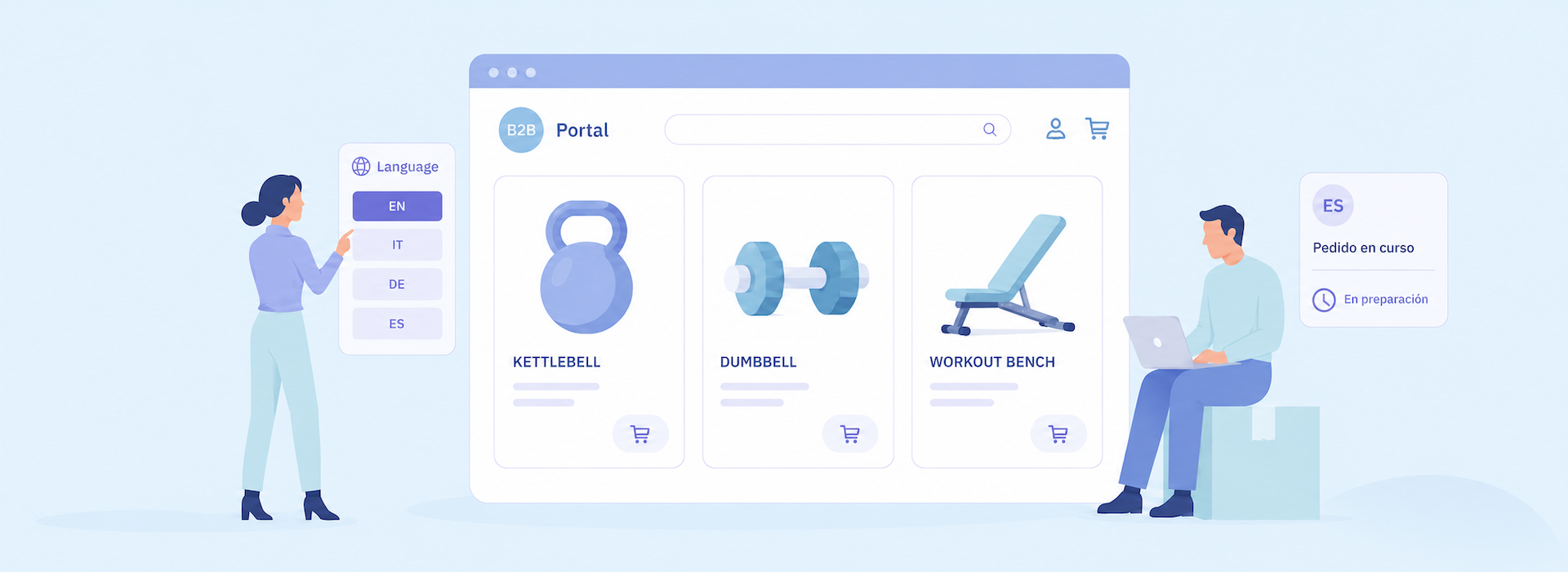
What they actually need is a B2B website builder: a platform that lets brands, distributors, suppliers, and manufacturers create a private, branded ordering portal for their business customers.
In this article, we’ll explore the features that matter most when evaluating a wholesale website builder.
Not All B2B Website Builders Are Built the Same – Or for Wholesale
Website builders are usually SaaS platforms that let you create working websites without coding. Some are designed mainly for creating pages, publishing content, capturing leads, and supporting basic digital selling.
That’s enough for B2C, D2C, or service-based B2B companies that need a simple online presence. But wholesalers and brands need more than a sleek, professional-looking website. They need a portal that supports how businesses actually purchase from other businesses. Contrary to standard website builders, a B2B eCommerce platform is designed specifically for wholesale operations. It combines the website-building aspect with advanced ordering workflows, puzzle-like pricing structures, rich product management controls, and deep integrations that go well beyond simple plug-ins. A drag-and-drop builder gives a wholesale business visibility, but it can’t replace a sales rep’s order pad or sync directly with your QuickBooks Online account.
A web design tool, however capable, isn’t purpose-built for wholesale.
1. A Login-Protected Branded Storefront
It looks like a website. It acts like a website. But the moment anyone can access your pricing, it’s just a website – not a wholesale ordering portal.
Wholesale buying is its own playbook. A login-protected storefront lets wholesale businesses control their catalog and pricing visibility. B2B pricing is confidential by nature, as it’s often negotiated for each buyer. Products may be exclusive to specific areas or accounts. Customers may need to register for an account and get approved before they can place a single order.
Without this capability, you either go fully public, which merely means exposing your pricing and products to anyone, or you rely on a separate sales process to share catalogs and pricing manually. Both options create friction either for your customers or your team.
What a B2B website builder does: A gated storefront is a wholesale website that requires customers to log in before they can view pricing, products, or place orders. Even if a website is public, pricing, terms, special offers, and ordering are visible only upon login, meaning they’re accessible only to the customers they’re meant for. Beyond access control, a wholesale website builder comes with design tools so you can create a custom B2B portal that reflects your brand, with your domain, colors, logo, copy, and fonts, because your customers are ordering from you, not from an impersonal platform.
2. Customer-Specific Pricing
Let’s play a round of The Price is Right. What’s the wholesale price for an empire-waist bridal gown? Here’s the catch: there isn’t a single universal answer to that. B2B pricing is highly specific to the customer. And sometimes even to the region. That’s not a quirk of wholesale. That’s just how it works.
A wholesale bridal brand manages pricing across dozens of boutique buyers, each with their own negotiated rates, terms, and order minimums. The brand also handles cost changes as additional requirements come, like adding a train or adjusting the dress length. A price guessing game wouldn’t last five minutes in wholesale.
What a B2B website builder does: Customer-specific pricing lets you assign individual price lists to each account, with negotiated rates, volume discounts, and category or product-level rules that vary by buyer. Each customer sees only the prices that apply to them, alongside the MSRP where relevant, so their profit margin is clear. A wholesale ordering portal also handles multiple currencies and location-based tax rules, so every buyer sees transparent pricing that’s accurate for their account and region.

3. Product Variants
Wholesale product variants are like a matrix that extends beyond typical product options, such as size and color. A workwear business, for example, may offer a T-shirt that customers can order in their brand colors, in multiple sizes, with their logo embroidered.
Now multiply that across thousands of products. Ella B. Candles, a custom candle wholesaler, faced exactly this challenge: a catalog of over 60,000 SKUs with customizable variants like scent, label, and bow colors, where thousands of products share the same basic SKUs. As Madeline Lemieux, Creative and Marketing Director at Ella B. Candles, explains: “We couldn’t find an eCommerce platform that would support having all these thousands of products that all use the same basic SKUs, which is kind of unique to us.” Today, they manage 10,000+ SKUs on B2B Wave, a consolidation made possible by its parent-child capabilities.
What a B2B website builder does: A B2B ordering platform handles variant structures across large catalogs. Unlike generic platforms that force complex options into separate SKUs, a wholesale website builder inherently accommodates that flexibility at scale. For wholesalers with highly personalized products, the difference between a platform that works with their catalog – and not against it – isn’t just convenient. It’s the whole point.
4. Privacy Groups
Wholesale product catalogs are like kombucha. Not for everyone. And that’s not a division drawn just because – it’s a deliberate decision.
You may have exclusive commercial agreements that restrict certain products to specific accounts. You may sell a product line in some regions but not others due to regulatory requirements. You may want to show a new product line only to your VIP buyers before rolling it out for everyone. Or you simply need different customers to see different catalogs without managing separate storefronts, while keeping the buying experience personalized and smooth for everyone.
Granular catalog control, or product privacy, is essential in B2B transactions. A wholesale website builder lets you control visibility at four levels: product, category, brand, and customer group. These work in multiple directions, granting exclusive access to select customers and restricting access from others, and they intersect across levels simultaneously.
In the words of Alfonso Tupaz, founder and CEO at Hatch Coffee, privacy groups are much like “a whole bunch of Venn diagrams, where specific customer groups form the intersection of exclusive product access and pricing.” He and his team use privacy groups to manage diverse price lists, product and category visibility across their wholesale accounts, offering exclusive pricing to partners, limiting certain products, like their oat milk line, to specific buyers, and tailoring their catalog for each customer.
What a B2B website builder does: Catalog control means each customer logs into a storefront that feels curated for them. And it is. The products they see, the categories they browse, and the brands available to them are all set up to reflect your relationship and commercial agreements. Instead of giving every customer the same view, a B2B eCommerce platform provides each customer with the right view.
5. Quotes
The storefront sets the stage. But wholesale purchasing often needs more than a polished ordering experience before a buyer hits confirm. A cabinetry manufacturer, for example, may need to provide quotes for highly customized designs before a buyer commits to an order, a level of commercial complexity that sits well outside of standard checkout. Quotes are inherent in wholesale, allowing both parties to negotiate pricing, specs, and volume. But they sometimes remain untracked or unstructured, spread over endless email chains. The worst part? Because of this lack of structure, they may remain “invisible” to anyone who joins the deal later.
What a B2B website builder does: Native quoting and RFQ capabilities enable transparent, efficient negotiations directly from your storefront, without endless email chains and miscommunications. Your team can prepare, review, and confirm quotes while customers review and accept them, all from the same place: your B2B portal.
6. Bulk Ordering and Reordering
B2B buyers aren’t discovering new products on every visit; they’re restocking in bulk. The ordering experience needs to support that: they need to be able to move swiftly through your wholesale website, see what’s available, what they’ve purchased in the past, and build and save their orders over time.
What a B2B website builder does: Effortless bulk ordering and reordering are essential in a wholesale website builder. Features like quick order, order history, one-click reorders, order uploads, and saved orders make buyers’ decision-making quicker and more confident. All this translates to more self-sufficient customers, faster ordering cycles, and less back-and-forth for your team. As Christopher Tassy, Co-founder at Ella B. Candles, puts it, “We have fewer conversations about stores going back and forth and people getting upset with us because they didn’t give us all their information. That’s time and emotion and money. So, it’s priceless.”
7. Sales Rep Portal and Mobile App
Sales reps should spend their days selling. Without a dedicated portal, reps default to phone calls, emails, and spreadsheets to get things done. A B2B eCommerce platform gives your sales team full visibility into customer accounts and order history. Reps can place and manage orders on behalf of any customer from any device. At the same time, admins and managers can track performance and activity in real time and set commissions for each rep or adjust them on existing orders when special circumstances call for it. Without a portal, rep activity is invisible to management, and customer relationships live in scattered inboxes rather than a shared system.
What a B2B website builder does: It gives your team two tools to make their work easier and more efficient. A dedicated sales rep portal lets them monitor customer orders, place orders on their behalf, manage assigned accounts, track sales performance, and keep a clear view of their commissions. For days in the field (trade shows, customer visits), a mobile app extends that capability beyond their desk, especially if it includes offline functionality that keeps orders moving regardless of a poor signal.
8. Integrations (Accounting, ERP, and more)
Let’s set the scene: It’s 2019, and Alfonso Tupaz, founder and CEO at Hatch Coffee, handles invoicing, chases payments that haven’t gone through, and follows up with customers who have switched payment details. The problem? Hours lost to manual admin work and a struggling cash flow.
But there’s a fix: Connecting their B2B eCommerce platform to QuickBooks Online. For Hatch Coffee, this meant reclaiming 4 hours a week from invoicing, getting payments 5 days sooner, and eliminating bad debt to “almost 0%.” But they didn’t stop there. A seamless connection to their in-house ERP through B2B Wave’s API allows them to “continue to be fast, but still with a relatively small team.”
What a B2B website builder does: A B2B ordering platform connects with the accounting, ERP, inventory, and payment tools you use and automates time-consuming tasks. Imagine inventory automatically updating after every order. Generating and sending an invoice the moment an order is submitted or shipped. Customers paying you on net terms or through ACH without waiting at checkout for your confirmation. That’s the native capability of a purpose-built wholesale website builder. The result is a team that’s efficient, accurate, and free to focus on growth.

9. Multi-User Accounts and Approval Workflows
B2B purchasing is sometimes like a relay race. A one-person login isn’t enough. Case in point: A store manager at a retail furniture store may place orders for their shop, while a regional manager may sign off on anything above a certain spend threshold for the locations under their oversight.
What a B2B website builder does: It supports multiple users under a single customer account, each with their own login and role-based permissions. Store managers can submit orders for approval. Regional managers can review, adjust, and finalize them. Order history and account activity stay organized at the account level, not scattered across individual logins. In wholesale, purchasing is rarely one person’s decision, and the system should reflect that.
10. PDF Catalogs
Reps walk into showrooms, attend trade shows, and sit across from buyers who want something tangible to look at, share internally, and bring to their team. In wholesale, pricing and product visibility change depending on whom you’re meeting with next. Imagine if they had to manually export product data for each customer and rebuild it into a presentable document in InDesign or Canva for every meeting.
What a B2B website builder does: A B2B ordering platform lets you quickly generate PDF catalogs directly from your live product data. You can create branded catalogs for each buyer so they only see the products and pricing relevant to them. Plus, customers can download their catalog directly from your B2B portal after signing in. A PDF catalog is the bridge between your wholesale ordering portal and the physical reality of sales.
When Is The Quest Over?
A B2B website builder combines all the features we explored above into a coherent ordering experience for your customers and your team. When evaluating wholesale website builders, the quest doesn’t end at the list of features they offer. It ends when you find a system that’s built around how your wholesale business works. If it can adapt to your pricing structures, your catalog needs, your team roles, and the systems you already use, then you’ve found your treasure chest.



.svg)

Join fast-growing B2B wholesalers, distributors, and brands who are automating their businesses.
No one does B2B eCommerce like B2B Wave. We’re fast, intuitive, error-free, and integrate with your current stack.
.svg)

.png)

.svg)