.png)
.png)
How a B2B eCommerce Platform Helps Wholesalers Scale Without Replacing Their ER



Key Takeaways
- Manual order processing is one of the biggest operational bottlenecks holding wholesale businesses back from real scale.
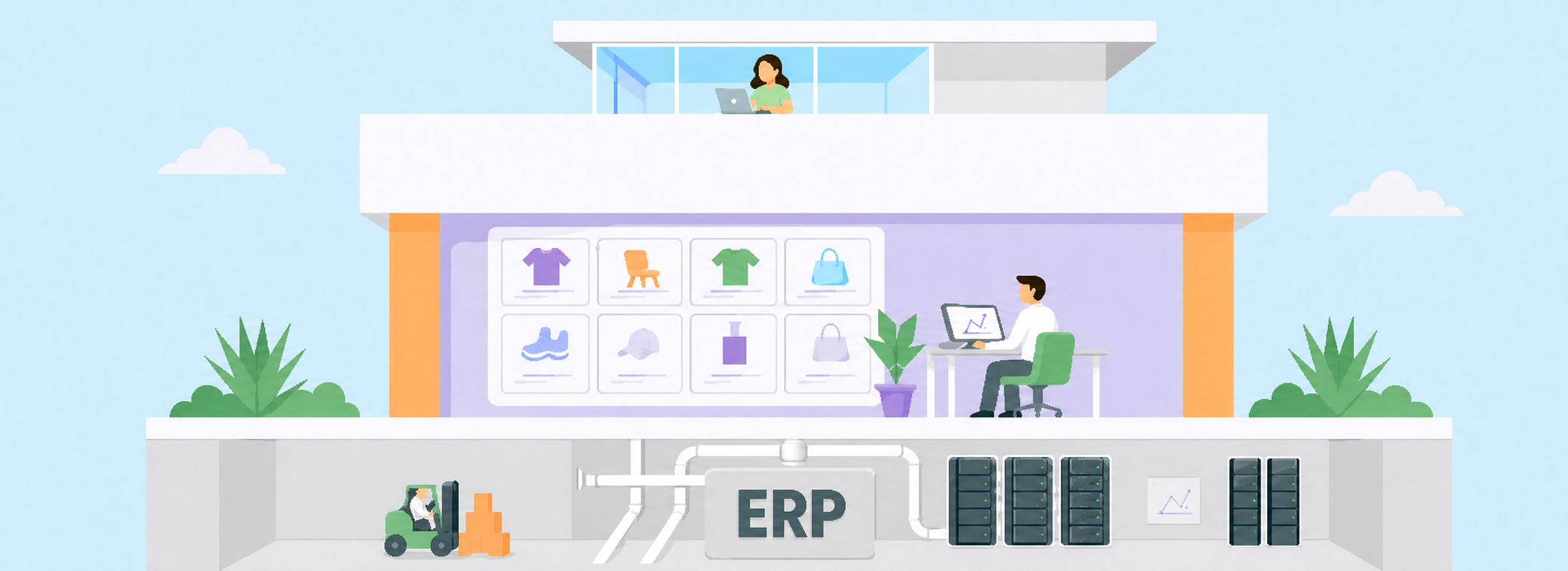
- A B2B eCommerce platform doesn’t replace your existing systems, like your ERP. It adds a digital ordering layer on top of the systems you already trust and use.
- Today’s B2B buyers expect convenience. If they still have to email you for a stock check or call for a quote, you’re already behind.
- Inventory, shipping, and accounting integrations are what turn a nice-looking portal into a genuine efficiency engine.
- The gains: Faster processing, fewer errors, lower cost per order, stronger retention, and the ability to scale without adding headcount.
There’s a quiet panic that sets in when a wholesale business owner realizes their current process isn’t working anymore.
Orders are coming in through email, phone, maybe the occasional fax (yes, still). Someone on the team (usually the person who’s been there the longest and knows where all the bodies are buried) is manually checking pricing. Someone else checks inventory and confirms stock. A third person confirms shipping. And then, another one enters everything into the system.
Most wholesale businesses operating this way have stopped seeing it as an issue. One order at a time? It’s just how things work. Until they don’t.
That’s the moment most people assume the only way forward is a full rip-and-replace. New ERP. New everything. Big project. Big budget. Big change. So they delay, sometimes for years, because the pain of change feels worse than the pain of staying put. And the longer they wait, the more expensive it gets.
Many wholesalers think they have a systems problem when what they really have is a buying-friction problem.
Do Wholesalers Need a B2B eCommerce Platform?
A B2B eCommerce platform is a digital ordering system purpose-built for wholesale and its intricacies, like:
- Customer-specific pricing
- Negotiated payment terms
- Volume discounts
- Minimum order quantities
- Product visibility
- Multi-user account management
For B2B brands and wholesalers, it replaces email orders, spreadsheets, and calls with a branded self-service portal that connects directly to their existing back-office systems (ERP, accounting).
Ultimately, it gives buyers a modern digital ordering experience. And wholesalers reclaim hours lost to unnecessary admin.
The Real Bottleneck Has Nothing to Do with Your Legacy Software
Many wholesale businesses assume their biggest obstacle is outdated technology. But that usually isn’t the whole story.
Manual order coordination is the silent killer of growth. Wholesale makes this messier than what it is in B2C. You’re not dealing with a simple one-price catalog, a one-off purchase, or a one-size-fits-all buying experience.
Think about what a single order actually involves in a traditional wholesale setup: Customers email repeat orders. They call to check stock. They wait for basic account information. Internal teams spend time re-entering data, confirming routine details, and managing exceptions across disconnected handoffs. And too often, the rules that keep orders moving live in one or two people’s heads. When they’re unavailable, the whole process slows down.
Every handoff in the chain is a chance for an error, a delay, or a miscommunication. The more orders you get, the worse those handoffs become. The result? Friction across the board: for buyers, for sales teams, and for operations.
“If It Ain’t Broke…”: How Do Wholesalers Scale B2B eCommerce Without Replacing Their ERP
The most common response to this realization is paralysis. “Our ERP works. Replacing it would be a nightmare.” And here’s the thing: that instinct isn’t entirely wrong.
ERP and accounting systems may not be glamorous, but they hold years of pricing logic, customer records, and operational history. Replacing all of that at once is expensive, risky, and slow. The businesses that do it often spend months in implementation hell before seeing a single improvement. Just this thought is enough to make anyone kick the project into the next quarter. Indefinitely.
So, there’s no need to rip out old systems. The smarter move is to add a B2B eCommerce layer on top and use it as the customer-facing interface for ordering, while creating a practical path to automation behind the scenes.
What changes is what buyers see: a clean, branded digital ordering portal that plugs directly into your backend: your ERP, accounting, inventory, and shipping tools. It’s a win-win. Buyers get the convenience of self-service. You get the operational stability of the systems your team already trusts. And nobody has to survive a year-long migration project to get there.
The right question isn’t “Should we replace our systems?” It’s “What customer-facing layer can we add that makes our existing systems work better?”

What Do Modern B2B Buyers Really Want from a B2B Ordering Portal?
Here’s a useful reality check: your wholesale buyers go home and shop on Amazon. Real-time tracking, instant stock visibility, one-click reordering. Then, on Monday morning, they email you to check whether a product is available. In practice, your competitors are no longer just other wholesalers. They are every company that has trained your buyers to expect speed, visibility, and self-service.
That gap is getting harder to paper over. Not only do B2B buyers prefer ordering online, but 67% of them favor a rep-free experience. You’re no longer just competing with other wholesalers in your category. You’re competing with every seamless digital experience your buyer has ever had.
What buyers actually want isn’t complicated. They want to check stock, reorder quickly from past purchases, and see their negotiated pricing the moment they log in. They also expect easy access to invoices and order tracking without involving your team. All this without emailing or calling you.
And here’s the part that surprises many wholesalers: going digital doesn’t remove the human element. B2B buyers aren’t asking for a robot or less service. They’re asking for more convenience and transparency. Your sales reps stop being order-entry clerks and start doing the work that actually nurtures accounts.
What Happens When Wholesalers Make the Switch
East Coast Tropicals, a wholesale plant distributor, is a good example of what this looks like in practice.
Before launching their B2B eCommerce platform, processing orders meant six people scrambling every Monday and Tuesday. Three sales reps were handling the details coming from 85 customers, manually.
After implementing B2B Wave on top of their existing systems, 90% of customers place orders online themselves. They also bridged QuickBooks Enterprise with B2B Wave, giving the team the best of both worlds: legacy accounting and wholesale ordering working in tandem.
Even better, the launch of a dedicated B2B portal for their seasonal spring product line delivered immediately: East Coast Tropicals saw a 40% increase in sales just by implementing that.
What Measurable Results Do Businesses See After Adopting Digital Ordering?
Let’s get concrete. Wholesalers that make this shift typically see measurable improvements across five areas:
Which Integrations Wholesale Businesses Really Need
A B2B ordering portal without backend integrations is like a movie set: polished on the surface, hollow where it counts. If your team is still copying data between systems, you haven’t modernized at all.
The real efficiency gains come from connecting three layers:
Accounting & ERP
Like: QuickBooks, Xero, Sage 200, Brightpearl
When orders, invoices, payment data, and customer records flow automatically between your B2B eCommerce solution and your back-office systems, you eliminate the manual reconciliation that eats hours every week. Your finance team gets clean data, your operations stay aligned, and your business gets better visibility into performance.
Inventory
Like: Cin7 Core, Fishbowl, Zoho Inventory
Your B2B portal stops being a mere digital catalog and becomes a real ordering system. If buyers can order online, but the portal doesn’t reflect actual stock, you still serve up friction – but online. Inventory integrations help keep stock levels updated, give customers a more reliable buying experience, and reduce order corrections.
Shipping
Like: ShipStation, Veeqo
They help automate carrier selection, rate calculation, label generation, and order tracking. Your team stops manually processing fulfillment details. Buyers get real-time visibility and a smoother experience after checkout.
No integration = no deep transformation. Connecting your systems is what turns efficiency into something real and measurable.

Where to Start Without Disrupting What Already Works
If you’ve been waiting for the “right time” to modernize, stop waiting for perfect.
Start smaller. Identify the single most painful friction point in your current process, the one that eats the most time from you, causes the most errors, or frustrates your customers most visibly. And start there.
Solve that first. Then solve the next thing. The businesses that digitize most successfully aren’t the ones that plan the most elaborate overhaul, but those that make the switch, get feedback, and keep improving.
In the end, a digital ordering portal that handles the bulk of your routine order flow is infinitely better than a “perfect” system that launches after many long months.
Ready to See What This Looks Like for Your Business?
B2B Wave helps wholesale distributors and manufacturers add a powerful digital ordering layer on top of their existing systems (no ERP replacement needed). Request a demo today and see what it can do for your business.




.svg)

Join fast-growing B2B wholesalers, distributors, and brands who are automating their businesses.
No one does B2B eCommerce like B2B Wave. We’re fast, intuitive, error-free, and integrate with your current stack.
.svg)

.png)

.svg)